


How to Sell AI Prompts Online in 2026 and Turn Your AI Skills Into Digital Products is a complete guide for creators, freelancers, marketers, developers, and AI enthusiasts who want to transform their prompt engineering skills into valuable digital products. Learn how to identify profitable prompt niches, create and test high-quality prompts, build professional prompt packs, set pricing, market your products, and sell AI prompts online to customers around the world.
Artificial intelligence is changing how people write, design, market products, create videos, develop software, research ideas, and operate businesses.
But behind almost every useful AI output is something critically important:
The prompt.
A carefully designed AI prompt can transform a general-purpose AI model into a marketing strategist, content creator, business analyst, coding assistant, image director, video producer, SEO specialist, sales assistant, or workflow automation tool.
That creates a growing opportunity for AI creators:
You can package your best AI prompts into digital products and sell them online.
Instead of keeping hundreds of useful prompts buried inside documents, notes, or AI chat histories, you can organize them into professional prompt packs, templates, workflows, and digital products that help other people achieve better results faster.
In this guide, you’ll learn:
- What selling AI prompts actually means
- Why people pay for premium prompts
- What types of AI prompts you can sell
- How to create prompts that have real commercial value
- How to build complete prompt systems
- How to package your prompts professionally
- How to price your prompt products
- How to market them
- How to turn prompts into branded digital products with MakeAIPrompt.com
Contents
- 1 What Does It Mean to Sell AI Prompts?
- 2 What Is Prompt Engineering?
- 3 Why Would Someone Pay for an AI Prompt?
- 4 What Makes an AI Prompt Worth Selling?
- 5 Sell Outcomes, Not Just Prompts
- 6 Types of AI Prompts You Can Sell
- 7 1. Business Prompts
- 8 2. Marketing Prompts
- 9 3. Social Media Prompts
- 10 4. AI Image Generation Prompts
- 11 5. AI Video Prompts
- 12 6. SEO Prompts
- 13 7. Ecommerce Prompts
- 14 8. Sales Prompts
- 15 9. Coding Prompts
- 16 10. Career and Productivity Prompts
- 17 Create Prompt Systems Instead of One-Line Instructions
- 18 Create Prompt Chains for Complex Tasks
- 19 Test Every Prompt Before Selling It
- 20 Clearly State AI Model Compatibility
- 21 Show Buyers What Your Prompt Can Produce
- 22 Package Your Prompts as a Professional Digital Product
- 23 Turn Your Prompts Into Branded Digital Products With MakeAIPrompt.com
- 24 How to Start Selling AI Prompts on MakeAIPrompt.com
- 25 Single Prompts vs Prompt Packs vs Prompt Systems
- 26 How to Name Your Prompt Product
- 27 How to Market Your AI Prompt Products
- 28 Use Free Prompts as a Marketing Strategy
- 29 Build Multiple Products Around One Niche
- 30 Common Mistakes When Selling AI Prompts
- 31 Copyright, Intellectual Property and AI Prompt Products
- 32 How to Make Your Prompt Products Harder to Replace
- 33 Can Selling AI Prompts Become a Business?
- 34 The Future Goes Beyond Individual Prompts
- 35 Useful Official Prompt Engineering Resources
- 36 Start Turning Your AI Knowledge Into Digital Products
- 37 Create. Package. Sell.
What Does It Mean to Sell AI Prompts?
Selling AI prompts means creating carefully structured instructions for AI models and packaging those instructions into digital products that other people can purchase and use.
A prompt product might contain:
- One advanced master prompt
- A collection of related prompts
- A step-by-step prompt workflow
- A prompt framework
- Prompt templates with editable variables
- An industry-specific prompt library
- Image-generation prompts
- AI video prompts
- Marketing prompt systems
- Agent instructions
- AI automation workflows
These prompts may be designed for AI tools and models such as:
- ChatGPT
- Claude
- Gemini
- Grok
- Midjourney
- FLUX
- Kling
- Runway
- Veo
- Stable Diffusion
- Other text, image, video and multimodal AI models
For example, instead of selling a basic prompt such as:
“Write an Instagram caption.”
you could create:
“50 AI Prompts for Creating High-Converting Instagram Content for Ecommerce Brands.”
The difference is significant.
The first prompt is a simple instruction that almost anyone could write.
The second product targets a specific customer, solves a defined problem and promises a clear workflow.
That is what prompt productization is about.
What Is Prompt Engineering?
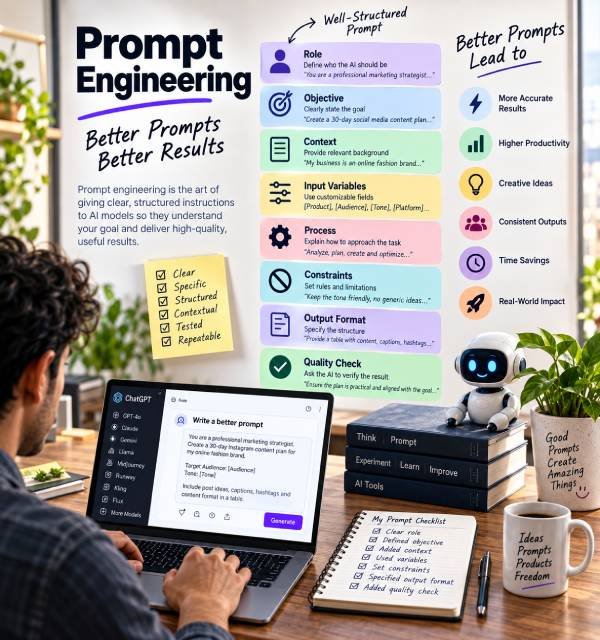
Prompt engineering is the process of designing, structuring, testing and improving instructions given to AI models so they produce more useful and predictable outputs.
OpenAI recommends clear, specific instructions, relevant context and explicit output requirements when prompting AI models. You can explore OpenAI’s official guidance here: OpenAI Prompt Engineering Best Practices
Google similarly describes prompt design as an iterative process involving clear instructions, examples, structure and refinement: Google Gemini Prompt Design Strategies
Anthropic also provides detailed guidance for prompting Claude, including using context, examples, clear roles and structured instructions: Anthropic Prompting Best Practices
These official resources are valuable references when designing prompt products because prompt behavior can vary between different AI models.
Why Would Someone Pay for an AI Prompt?
Anyone can type something into ChatGPT, Gemini, Claude or another AI system.
So why would somebody buy a prompt?
Because creating a prompt and creating a reliable AI workflow are two very different things.
A professional prompt can contain:
- AI role
- objective
- business context
- user inputs
- constraints
- examples
- workflow instructions
- output structure
- tone
- formatting requirements
- validation criteria
- quality controls
- reusable variables
People may pay because a well-designed prompt can help them:
Save Time
Instead of spending hours experimenting, they can start with a tested workflow.
Get More Consistent Results
Structured instructions can make output more predictable.
Learn How to Use AI Better
A good prompt can act like a template that teaches users what information an AI model needs.
Automate Repetitive Tasks
Businesses may repeatedly need product descriptions, reports, marketing ideas, emails or research.
Access Specialized Knowledge
A marketer, developer, recruiter, designer, consultant or industry specialist can encode expertise into a repeatable prompt framework.
People are therefore not simply buying words.
They are buying:
knowledge + structure + testing + convenience + time savings.
What Makes an AI Prompt Worth Selling?
Not every AI prompt should become a paid product.
A commercially valuable prompt typically solves a specific problem for a specific audience.
Consider this basic prompt:
Create a marketing strategy for my business.
It’s usable, but extremely easy to recreate.
Now imagine a prompt that first collects:
- Business type
- Product
- Target audience
- Country
- Budget
- Competitors
- Existing acquisition channels
- Brand position
- Revenue goal
- Available resources
Then instructs the AI to produce:
- Market analysis
- Customer personas
- Competitor positioning
- Core messaging
- Acquisition strategy
- Content strategy
- Advertising plan
- Conversion funnel
- 30-day execution roadmap
- KPI dashboard
That is no longer just a question.
It is a marketing strategy system powered by AI.
That has significantly greater product potential.
Sell Outcomes, Not Just Prompts
This is one of the most important principles for anyone who wants to sell prompts.
Compare:
Product A
500 ChatGPT Prompts
Product B
The 30-Day Instagram Growth Prompt System for Local Businesses
Product A contains more prompts.
Product B communicates a clearer outcome.
Customers generally care more about what the product helps them accomplish than how many prompts it contains.
Instead of asking:
“How many prompts should I sell?”
ask:
“What result can someone achieve using these prompts?”
That small change can completely transform how you create prompt products.
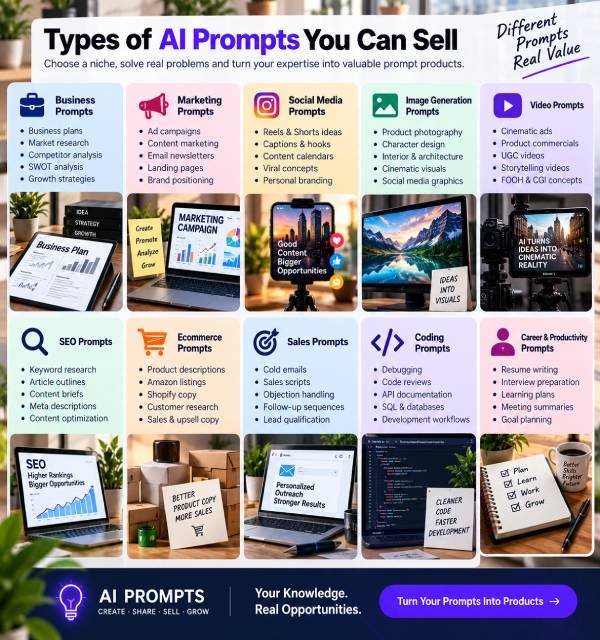
Types of AI Prompts You Can Sell
There are thousands of potential prompt categories.
The strongest category is often one connected to your knowledge, experience or audience.
1. Business Prompts
Business owners increasingly use AI for everyday operations.
Potential prompt products include:
- Business plan prompts
- Startup validation prompts
- Market research prompts
- Competitor analysis prompts
- SWOT analysis prompts
- Customer persona generators
- Business idea generators
- Pricing strategy prompts
- SOP creation prompts
- Product positioning systems
- Business growth prompts
- Management prompts
- Strategy prompts
Instead of producing unrelated prompts, package them around a business outcome.
For example:
AI Startup Launch Kit: 75 Prompts From Idea Validation to Go-To-Market Strategy
2. Marketing Prompts
Marketing is an especially strong prompt category because marketers constantly need new campaigns, ideas, content and analysis.
Products could include prompts for:
- Marketing strategies
- Meta advertising
- Google Ads
- Instagram campaigns
- Influencer marketing
- Email campaigns
- Landing pages
- Conversion funnels
- Customer research
- Brand positioning
- Product launches
- Conversion optimization
- Campaign analysis
- Retargeting campaigns
For example:
Ultimate AI Marketing Campaign Builder
Rather than giving customers 100 unrelated marketing prompts, create a process that takes them from research to execution.
3. Social Media Prompts
Creators and businesses constantly need fresh content.
You can create prompts for:
- Instagram Reels
- YouTube Shorts
- TikTok
- X
- Hooks
- Captions
- Calls-to-action
- Viral content concepts
- Content calendars
- Storytelling
- Personal branding
- Product promotion
Example:
100 Viral Reel Prompts for Ecommerce Brands
A niche-specific product immediately tells customers whether it is relevant to them.
4. AI Image Generation Prompts
AI image generation is another major opportunity.
Prompt packs can target:
- Product photography
- Fashion photography
- Interior design
- Architecture
- Advertising
- Character design
- Cinematic scenes
- Food photography
- Luxury branding
- Posters
- Social media graphics
- Thumbnails
- Concept art
A premium image prompt should ideally explain variables such as:
- Subject
- Environment
- Composition
- Lighting
- Lens
- Camera angle
- Texture
- Color palette
- Mood
- Aspect ratio
- Rendering style
Good prompt products should also contain sample outputs whenever possible.
5. AI Video Prompts
AI video prompting is becoming significantly more sophisticated.
Creators can develop products for:
- Cinematic advertisements
- Product commercials
- UGC videos
- CGI advertisements
- FOOH campaigns
- Short films
- Social-media videos
- Transformation videos
- Influencer campaigns
- Cinematic storytelling
- Realistic POV videos
- Brand campaigns
Advanced AI video prompts may define:
- Camera behavior
- Camera movement
- Subject continuity
- Motion
- Realistic physics
- Lighting
- Environment
- Character identity
- Dialogue
- Lip synchronization
- Timeline
- Scene continuity
- Audio
- Transitions
- Negative constraints
A premium video prompt can therefore become much closer to a production blueprint than a simple text instruction.
6. SEO Prompts
SEO specialists can package workflows for:
- Keyword research
- Search intent
- Topical maps
- Content briefs
- Article structures
- Internal linking
- Meta descriptions
- Competitor analysis
- Content optimization
- Schema suggestions
- Content refreshing
- SERP analysis
Example:
AI SEO Content System: From Keyword Research to Published Article
7. Ecommerce Prompts
Ecommerce sellers repeatedly perform similar tasks, making this another promising prompt category.
Possible products include:
- Product descriptions
- Amazon listings
- Shopify copy
- Product names
- Product titles
- Customer personas
- Review analysis
- Advertising campaigns
- Upsell copy
- Abandoned-cart emails
- Product photography prompts
- Competitor research
You could combine these into:
The Complete Ecommerce AI Prompt Toolkit
8. Sales Prompts
Sales teams and freelancers can use AI prompts for:
- Cold emails
- Sales scripts
- Prospect research
- Objection handling
- Follow-ups
- Discovery questions
- Proposal writing
- Lead qualification
- Personalized outreach
- LinkedIn prospecting
Instead of selling:
20 Sales Prompts
consider:
B2B Cold Outreach AI System: Research, Personalize, Write and Follow Up
The second product communicates the workflow and outcome.
9. Coding Prompts
Developers can sell specialized prompt frameworks for:
- Debugging
- Code reviews
- Software architecture
- SQL
- API documentation
- Unit testing
- Refactoring
- Database design
- React
- Node.js
- Python
- DevOps
- Security review
These prompts should be positioned as productivity tools rather than substitutes for professional engineering or security validation.
10. Career and Productivity Prompts
Possible products include:
- Resume writing
- Cover letters
- Interview preparation
- Learning plans
- Meeting summaries
- Productivity frameworks
- Goal planning
- Project management
- Professional emails
- Research systems
These can become especially useful when designed for specific professions.
For example:
50 AI Career Prompts for Software Developers

Create Prompt Systems Instead of One-Line Instructions
As AI models become more capable, extremely basic prompts become easier to generate.
That means premium prompt sellers should focus increasingly on:
systems + expertise + workflows.
A strong prompt framework might contain:
ROLE
Define who the AI should behave like.
Example:
You are a senior ecommerce marketing strategist with expertise in paid acquisition, customer psychology and conversion optimization.
OBJECTIVE
Explain the exact result required.
CONTEXT
Provide information about the user’s situation.
INPUT VARIABLES
Use customizable fields such as:
[PRODUCT]
[TARGET AUDIENCE]
[COUNTRY]
[BUDGET]
[GOAL]
[TONE]
PROCESS
Explain how the task should be approached.
CONSTRAINTS
Define limitations and important rules.
OUTPUT FORMAT
Specify exactly how the answer should be formatted.
QUALITY CHECK
Tell the model to verify requirements before finalizing the output.
This framework turns a simple prompt into a reusable system.
Create Prompt Chains for Complex Tasks
Some problems are too complex for a single prompt.
In those cases, you can create a chain.
For example:
Prompt 1
Research the market.
Prompt 2
Analyze the target audience.
Prompt 3
Identify positioning opportunities.
Prompt 4
Generate the marketing strategy.
Prompt 5
Create advertising concepts.
Prompt 6
Generate social-media content.
Prompt 7
Build a 30-day campaign calendar.
Google’s official prompting documentation specifically discusses breaking complex tasks into components and chaining prompts when sequential steps are required. Read Google’s Prompt Design Strategies
This is another reason prompt systems can offer more value than isolated prompts.
Test Every Prompt Before Selling It
Paid prompts should be tested.
Run each important prompt multiple times.
Change the inputs.
Try different industries.
Test edge cases.
Check whether the output remains useful.
Ask:
- Does the AI understand the goal?
- Is the output consistent?
- Are the variables easy to customize?
- Does the output follow the requested structure?
- Does it work with the model you’re advertising?
- Can a beginner understand the instructions?
- Does it solve the intended problem?
- Is anything unnecessarily complicated?
Prompt engineering is inherently iterative.
OpenAI recommends refining prompts based on results rather than expecting the first version to be perfect. OpenAI Guide to Creating Better Prompts
Clearly State AI Model Compatibility
Don’t assume one prompt will behave identically across every model.
If you’ve tested a prompt with:
ChatGPT
say so.
If it works best with:
Claude
mention it.
If the product is designed for:
Gemini
make that clear.
The same principle applies to:
- Midjourney
- FLUX
- Kling
- Veo
- Runway
- Stable Diffusion
- Other AI models
Different models may interpret instructions differently.
Official documentation should also be periodically reviewed because model capabilities and prompting recommendations evolve.
Useful references include:
OpenAI Prompt Engineering Documentation
Google Gemini Prompt Design Guide
Anthropic Claude Prompting Guide
Show Buyers What Your Prompt Can Produce
Selling a prompt without demonstrating its output forces customers to guess whether it is useful.
Whenever appropriate, show examples.
For Image Prompts
Show generated images.
For Video Prompts
Show sample videos or frames.
For Business Prompts
Show a sample report structure.
For Marketing Prompts
Show campaign outputs.
For Copywriting Prompts
Show before-and-after examples.
For Coding Prompts
Show the workflow and intended use case.
The objective isn’t to give your entire premium product away.
It is to provide enough evidence for customers to understand what they are purchasing.
Package Your Prompts as a Professional Digital Product
Presentation matters.
Instead of giving customers an unorganized text file, turn your prompts into something that feels like a complete product.
A professional prompt product can include:
Cover
A professional title and design.
Introduction
Explain what the product does.
Target Audience
Tell customers who the product is intended for.
Supported AI Models
List the platforms you’ve tested.
Instructions
Explain how to use the prompts.
Prompt Categories
Organize prompts into logical sections.
Variables
Clearly highlight what buyers should customize.
Examples
Provide sample outputs.
Advanced Tips
Explain how buyers can improve results.
Usage Terms
Clarify how the product may be used.
Turn Your Prompts Into Branded Digital Products With MakeAIPrompt.com
This is where MakeAIPrompt.com can simplify the entire process.
If you’ve already created useful prompts, you shouldn’t necessarily need to build an ecommerce platform from scratch simply to package and sell them.
With the MakeAIPrompt Digital Product Builder, creators can transform their AI prompts into branded digital products.
The process can be summarized as:
Create → Package → Publish → Sell
Creators can organize prompts into professional products, define their offer, set their own pricing and conditions, and make those products available through MakeAIPrompt.
This turns MakeAIPrompt into more than a place for discovering AI prompts.
It becomes a platform where creators can transform AI knowledge into sellable digital assets.
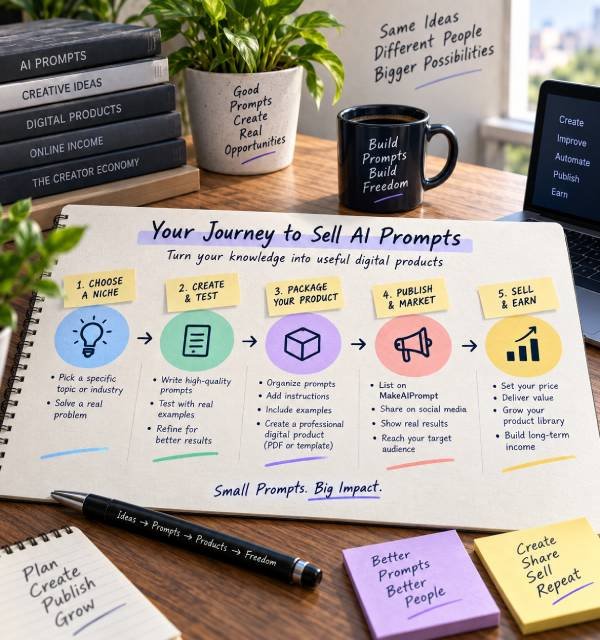
How to Start Selling AI Prompts on MakeAIPrompt.com
Step 1: Choose a Specific Niche
Avoid trying to create prompts for everyone.
For example:
Too Broad:
AI Marketing Prompts
Better:
AI Marketing Prompts for Restaurants
Even Better:
50 AI Prompts to Help Restaurants Create 30 Days of Instagram Content
Specific products are easier to understand and market.
Step 2: Identify the Buyer
Ask:
Who needs this product?
Your buyer might be:
- Freelancer
- Small-business owner
- Content creator
- Marketing agency
- Developer
- Ecommerce seller
- YouTuber
- Designer
- Consultant
- Student
- Startup founder
Design the prompts around their real workflow.
Step 3: Identify a Valuable Problem
A strong product generally helps customers:
- Save time
- Reduce repetitive work
- Generate content
- Generate ideas
- Improve consistency
- Structure complex tasks
- Learn an AI workflow
- Produce specific outputs
- Research faster
- Automate processes
The clearer the problem, the easier it becomes to build the product.
Step 4: Build the Prompt Collection
Create prompts around the chosen outcome.
Avoid unnecessary repetition.
Every prompt should have a purpose.
For larger products, divide prompts into stages or categories.
Step 5: Test Everything
Test realistic inputs.
Save strong output examples.
Rewrite prompts that produce inconsistent results.
Remember:
You’re selling tested knowledge and workflows—not simply AI-generated text.
Step 6: Create Your Digital Product
Use the MakeAIPrompt Digital Product Builder to turn your prompt collection into a more polished product.
Add:
- Product title
- Description
- Cover
- Prompt content
- Instructions
- Examples
- Terms
- Pricing
Step 7: Set Your Price
There is no universal correct price for an AI prompt product.
Consider:
- Prompt complexity
- Specialization
- Number of prompts
- Testing
- Commercial usefulness
- Documentation
- Examples
- Niche expertise
- Uniqueness
- Buyer value
Don’t assume that more prompts automatically justify a higher price.
Ten specialized prompts solving an expensive business problem could be more valuable than thousands of generic prompts.
Single Prompts vs Prompt Packs vs Prompt Systems
Prompt products can be divided into three general levels.
Level 1: Single Prompt
One specialized prompt designed to perform one task.
Level 2: Prompt Pack
A collection of related prompts.
Example:
50 Real Estate Marketing Prompts
Level 3: Prompt System
An interconnected collection that guides the buyer through a complete workflow.
Example:
Complete AI Real Estate Marketing System
It could contain:
Research → Positioning → Listing Copy → Social Content → Advertising → Email Follow-Up
Prompt systems can create stronger differentiation than generic prompt collections.
How to Name Your Prompt Product
Avoid generic titles such as:
100 Best AI Prompts
Instead consider:
100 AI Prompts for Freelancers to Find Clients, Write Proposals and Deliver Projects Faster
Or:
50 AI Video Prompts for Creating Cinematic Product Commercials
Or:
The AI Ecommerce Launch Kit: 75 Prompts for Product Research, Branding, Ads and Sales
A useful title formula is:
[Number/Format] + [Prompt Type] + [Target Audience] + [Desired Outcome]
Your title should quickly tell the buyer:
What is this?
Who is it for?
What does it help me achieve?
How to Market Your AI Prompt Products
Creating the product is only half of the job.
You also need distribution.
You can market prompt products through:
- Google Search
- YouTube
- X
- Blogs
- Newsletters
- Online communities
- Short-form videos
- SEO
- Your existing audience
Avoid repeatedly publishing:
“Buy my prompt pack.”
Instead, demonstrate results.
For example:
“I created this entire advertising campaign using one structured AI workflow.”
Show the result first.
Then explain that the complete prompt system is available as a product.
Show the outcome. Sell the system.
Use Free Prompts as a Marketing Strategy
Not every prompt needs to be paid.
Free prompts can introduce users to your expertise.
For example:
Free Product
5 Viral Instagram Prompts
Premium Product
100-Prompt Instagram Growth System
If the free product genuinely helps users, they may be more interested in your premium collection.
Build Multiple Products Around One Niche
Once you create expertise in one market, you can create multiple products.
Suppose your niche is ecommerce.
You could develop:
Product 1: Ecommerce Product Description Prompts
Product 2: Ecommerce Advertising Prompts
Product 3: Ecommerce Product Photography Prompts
Product 4: Ecommerce Email Marketing Prompts
Product 5: Ecommerce Social Media Prompts
Then bundle everything into:
Ultimate Ecommerce AI Prompt Bundle
One area of expertise can become an entire portfolio of digital products.
Common Mistakes When Selling AI Prompts
Selling Generic Prompts
If someone can recreate the prompt in seconds, commercial differentiation will be limited.
Add expertise, structure and workflow.
Focusing Only on Quantity
Thousands of prompts sound impressive, but buyers ultimately need useful results.
Quality matters more than quantity.
Providing No Examples
Customers need to understand what your prompt can produce.
Providing No Instructions
Don’t assume every customer understands prompt engineering.
Ignoring AI Model Differences
Prompts may behave differently across models.
State compatibility clearly.
Making Unrealistic Income Claims
Prompt selling is a digital-product business, not guaranteed passive income.
Marketing, distribution, customer acquisition, product quality and positioning all matter.
Copying Other Sellers
Create original prompt frameworks based on your own knowledge, experience and testing.
Never Updating Products
AI models evolve quickly.
Periodically retest your strongest products.
Copyright, Intellectual Property and AI Prompt Products
Creators should also think carefully about intellectual property.
Avoid simply copying prompts, documentation or proprietary content from other creators and reselling it.
Create original products.
When your prompt outputs incorporate AI-generated images, text, video, music or other material, copyright treatment may vary by country and circumstance.
The World Intellectual Property Organization notes that generative AI introduces significant questions relating to intellectual property, ownership and copyright.
For creators and businesses interested in the subject, WIPO provides a useful introduction here:
WIPO — Generative AI: Navigating Intellectual Property
WIPO also maintains broader resources covering AI and intellectual property:
WIPO Artificial Intelligence and Intellectual Property Resources
This article is educational information and should not be considered legal advice. Sellers should review applicable laws and the terms of the AI platforms they use.
How to Make Your Prompt Products Harder to Replace
Generic prompts will continue becoming easier to generate.
Your competitive advantage therefore shouldn’t simply be:
“I can write prompts.”
Build around the following:
Domain Expertise
Know something valuable about marketing, design, ecommerce, coding, video production, sales or another industry.
Testing
Understand which instructions produce reliable results.
Workflow Design
Connect prompts into useful systems.
Examples
Demonstrate outcomes.
Convenience
Save customers hours of experimentation.
Organization
Turn scattered expertise into an easy-to-follow product.
Updates
Keep your strongest products relevant as AI models evolve.
Brand
Build trust around the quality of your prompt products.
The text of a prompt may be easy to copy.
Your expertise, workflow, examples, testing, packaging and brand are much harder to replicate.
Can Selling AI Prompts Become a Business?
Potentially.
But it should be approached as a digital-product business, not as a shortcut to effortless income.
The strongest opportunity isn’t necessarily:
“I sell AI prompts.”
It is:
“I sell AI-powered solutions to specific problems.”
A marketer can sell an AI campaign system.
A photographer can sell AI photography workflows.
A developer can sell coding frameworks.
A recruiter can sell recruitment workflows.
A creator can sell social-content systems.
A consultant can transform a repeatable methodology into an AI-assisted workflow.
Your existing expertise becomes the foundation of your product.
The Future Goes Beyond Individual Prompts
The next generation of AI products will increasingly include:
- Master prompts
- Prompt chains
- Prompt libraries
- Prompt templates
- AI playbooks
- Agent instructions
- Automated workflows
- AI frameworks
- Niche-specific AI systems
- Digital prompt products
The opportunity is moving beyond simply finding the perfect sentence to give an AI model.
It is about designing systems that help people get valuable work done with AI.
Useful Official Prompt Engineering Resources
If you want to improve your prompt-building skills before creating products, these official resources are worth bookmarking.
OpenAI
Learn how to create clearer and more effective prompts for ChatGPT and OpenAI models.
OpenAI Prompt Engineering Best Practices
Google Gemini
Learn prompt design principles, examples, prompt chaining and structured instructions.
Google Gemini Prompt Design Strategies
Anthropic Claude
Explore Anthropic’s recommendations for prompting Claude models.
Anthropic Prompting Best Practices
World Intellectual Property Organization
Learn about intellectual-property considerations surrounding generative AI.
WIPO Generative AI and Intellectual Property Guide
These authoritative external resources can help creators understand both the technical side of prompting and some of the broader considerations surrounding AI-generated content.
Start Turning Your AI Knowledge Into Digital Products
If you already use AI regularly, you may already have potentially valuable prompts hidden inside:
- Chat histories
- Documents
- Notes
- Projects
- Client workflows
- Personal templates
Look through them.
Ask yourself:
Which prompts have I improved repeatedly?
Which ones consistently save me time?
Which workflows produce useful results?
What problems do other people repeatedly face?
Can I turn my solution into a reusable AI system?
Those workflows could potentially become digital products.
Start with one niche.
Solve one useful problem.
Build a high-quality prompt system.
Test it.
Package it professionally.
Demonstrate what it can produce.
Then put it in front of the people who need it.
With MakeAIPrompt.com, you can take the prompts and AI workflows you’ve developed and transform them into branded digital products designed to be shared and sold to a wider audience.
Create. Package. Sell.
Your best prompts don’t have to remain buried inside your AI chat history.
Turn your knowledge into a professional digital product and start building your AI prompt business with MakeAIPrompt.com.